
How protocols get caught
Every tunnel protocol leaves a fingerprint. The handshake has a shape, the packets have a rhythm, and a DPI system that has seen the pattern before can match it in milliseconds.
WireGuard is fast, modern, and a great default on a normal network. On a hostile one, its handshake is distinctive enough that it gets identified reliably, often within hours of a server coming up. OpenVPN has been a known quantity for years. IKEv2 is UDP traffic with a recognizable signature, so it tends to get throttled or dropped outright on aggressive networks.
None of these are bad protocols. They were designed to be efficient and interoperable, not to hide. Hiding is a different job.
Why VLESS + REALITY is the current answer
The protocol most people in heavily filtered networks actually rely on right now is VLESS, usually with the REALITY transport, run through Xray. The reason is unromantic. It doesn't try to encrypt the tunnel in some clever new way. It tries to look like nothing at all.
REALITY makes your connection look identical to an ordinary HTTPS request to a real, popular website. It borrows that site's genuine TLS certificate during the handshake, so when a censor probes your server, it answers exactly the way the real site would. There's no statistical anomaly to flag, because as far as the inspection system can tell, you're just one more person loading a major website.
Community testing through early 2026 put VLESS + REALITY + Vision bypass rates around 98 percent, while older approaches that wrap VPN traffic in TLS kept getting fingerprinted. That gap is the whole reason the privacy community moved.
The part nobody mentions: the IP is the weak link
Here's where most "best protocol" guides stop, and where the real problem starts.
REALITY hides what your traffic is. It does nothing to hide where it comes from. Your server has an IP address, and that address is the thing a censor can actually block once it notices you, no matter how invisible the protocol is.
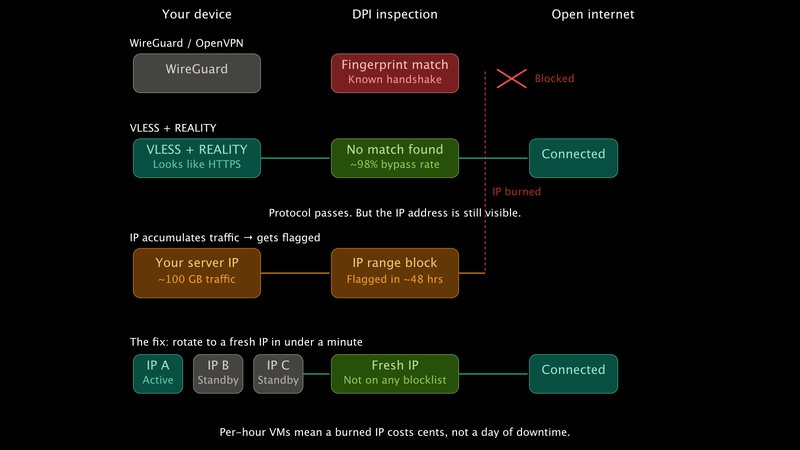
And it does notice. Operators report that an IP pushing around 100 GB of REALITY traffic tends to get blocked within about 48 hours on the most aggressive networks. The protocol is fine. The IP burned. Which means the durable skill isn't picking a protocol, it's being able to move.
That's why server rotation and disposable infrastructure have quietly become standard practice. You don't protect one perfect server. You keep your config portable, run more than one node, and stand up a fresh IP the moment the old one goes quiet.
This is the case for self-hosting that has nothing to do with ideology and everything to do with mechanics. A commercial VPN shares one IP across thousands of users, so when that IP gets flagged, everyone on it drops at the same moment, and you wait for the provider to react. A server you control is on nobody's blocklist until it personally earns attention, and when it does, you rotate it yourself in minutes instead of hours.
What a resilient setup actually looks like
You don't need anything exotic. You need redundancy and the ability to move.
- Run more than one protocol. WireGuard for speed on normal networks, plus VLESS + REALITY as the fallback for when plain tunnels get filtered. Switching should be a tap, not a rebuild.
- Keep your config portable. Back up your keys and server config somewhere you can reach even when your main connection is down. The worst time to go looking for them is mid-blackout.
- Have a spare you can spin up fast. A clean IP you can deploy in under a minute is worth more than a powerful server you can't replace. Per-hour billing makes this cheap, because a standby node costs almost nothing until you need it.
- Spread across regions. One server in one location is one decision away from being unreachable. Two servers in two regions is a different risk profile entirely.
Tools like AmneziaVPN package the whole stack, WireGuard plus obfuscated transports, with an installer that deploys each service in its own container over SSH. You can also assemble the pieces yourself with Xray and a clean VM. Either way, the deployment target is the same: a general-purpose server with a dedicated IP that you can create and destroy on demand.
That last part is where a Doprax VM fits naturally. Dedicated IP, multiple regions, per-hour billing, and a deploy that takes under a minute, so rotating a burned node is a routine action rather than a project.
Pick your protocols before you need them, and make sure moving to a fresh IP is something you've already practiced.